
The Silence
Overview
Don DeLillo’s The Silence is a short novel first published by Scribner on October 20, 2020. At about 128 pages, it is a spare, speculative work about technological collapse, public life, and the fragility of the stories people use to make sense of the world. The novel is set in 2022, on the night of the Super Bowl, and opens with an epigraph attributed to Albert Einstein: the familiar warning that a third world war might be fought with advanced weapons, while a fourth would be fought with sticks and stones. The quotation frames the book with the possibility that modern civilization could destroy itself—and that whatever follows might begin again from almost nothing.
Plot and themes
Jim Kripps and his wife, Tessa Berens, are flying from Paris toward their home in Newark when their passenger plane suffers an emergency and crash-lands. Afterward, they join several other people in a Manhattan apartment. The group’s evening is initially organized around the Super Bowl and ordinary conversation. Then screens and digital systems fail on a vast scale, cutting the apartment’s occupants off from the familiar channels through which they receive information and maintain contact with the outside world. The novel brings five central characters together in this enclosed setting, where a global technological breakdown becomes less a puzzle to solve than a condition they must confront. The emergency landing and the blackout are the principal events; much of the book consists of talk, conjecture, recollection, and pauses rather than conventional action.
The outage unsettles more than convenience. In a society accustomed to finding news, work, entertainment, and social connection through electronic devices, the sudden loss of those systems raises questions about dependence and identity: how do people know what is happening, and how do they know who they are, when the screens go dark? The characters’ conversations range across subjects including a telescope in north-central Chile, bourbon, and Einstein’s 1912 manuscript on relativity. Their leaps between topics suggest both the reach of modern knowledge and the impulse to find a pattern in a crisis that resists explanation. Silence in the novel is therefore technological and psychological: devices fall quiet, public life becomes inaccessible, and speech continues without necessarily producing understanding. DeLillo connects these immediate disruptions to fears of war, civilizational collapse, and the limits of language.
Context and place in DeLillo’s work
The book revisits concerns that run through DeLillo’s fiction: the power of media to shape experience, the vulnerability beneath technological confidence, and the way collective events influence private consciousness. Its enclosed apartment, emergency landing, scientific manuscript, and televised football game also recall recurring motifs in his earlier work. The Super Bowl is particularly characteristic of his interest in sports as a shared American spectacle, one that can reveal how people imagine community and belonging. Although DeLillo began writing The Silence before COVID-19 existed, its fictional world remembers a virus that emptied streets. That detail gave the novel’s portrayal of disrupted routines and large-scale uncertainty an especially immediate resonance upon its publication in 2020.
Often described as DeLillo’s eighteenth novel, The Silence is among his most compressed late works. Rather than deliver a technically detailed account of the catastrophe or a conventional resolution, it uses dialogue and a near-theatrical concentration on a few people to make uncertainty itself the subject. Its austerity can frustrate readers looking for a fuller plot, but it also sharpens the book’s questions about what remains when familiar systems of communication disappear. The novel’s lasting interest lies in this concentrated late-career restatement of DeLillo’s central preoccupations: media, language, technology, and the precarious terms on which people share a reality.
About the Author
Early life and education
Don DeLillo was born in the Bronx, New York City, on November 20, 1936, and grew up in an Italian American family. He attended Fordham University, graduating in 1958 with a bachelor’s degree in communications arts. After college, he worked as an advertising copywriter. The discipline of advertising—its brief, persuasive language and its close attention to public images—provides useful context for his later fascination with slogans, mass communication, consumer culture, and the ways language can influence perception. He began writing fiction while working in advertising and eventually made literature his principal career.
Works and career
DeLillo’s first novel, Americana, appeared in 1971. His early books include End Zone (1972), Great Jones Street (1973), Ratner’s Star (1976), Players (1977), and Running Dog (1978). Across these works he developed a distinctive approach to contemporary life: his characters inhabit a world shaped by media, technology, commerce, and political power, yet often struggle to distinguish direct experience from the public images and language surrounding them.
The Names (1982) explored language, signs, and international experience. His eighth novel, White Noise (1985), brought together consumer culture, environmental danger, media spectacle, and fear of death, combining dark humor with philosophical inquiry. It won the National Book Award. Libra (1988), a novel engaging with the assassination of John F. Kennedy and the surrounding culture of conspiracy, was a National Book Award finalist and received the first Irish Times International Fiction Prize. Mao II (1991) examined writers, terrorism, and mass media. The sweeping Underworld (1997), which ranges across the second half of twentieth-century America, is widely regarded as one of his major achievements and an important work of contemporary American fiction. It was a National Book Award and Pulitzer Prize finalist. Later novels include The Body Artist (2001), Cosmopolis (2003), Falling Man (2007), Point Omega (2010), Zero K (2016), and The Silence (2020). In addition to novels, DeLillo has written short stories, plays, screenplays, and essays. His story collection The Angel Esmeralda: Nine Stories was published in 2011.
Reputation
DeLillo is frequently associated with postmodernism, though the range and evolution of his work resist an easy classification. Across several decades, he has returned to television and digital media, nuclear conflict, sports, language, historical memory, and collective fear. His fiction asks how such forces shape private consciousness and alter the way people understand reality. The National Book Award for White Noise, the recognition given to Libra, and the major award nominations for Underworld mark a career of sustained literary distinction. His reputation rests on a body of work noted for its compressed, rhythmic prose, its alertness to popular culture, and its examination of anxiety in modern society. DeLillo, born in 1936, is living; his influence comes from the cumulative force of novels that have helped define American writing about media, technology, and contemporary history.
StoryFlow

The Flight’s Progress
This thread follows Jim Kripps and Tessa Berens from the uneasy routine of their return flight into the sudden emergency that breaks it.
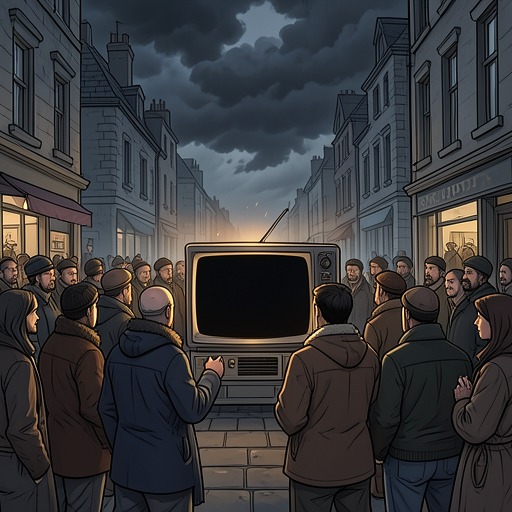
The Apartment’s First Blackout
This flow traces how an ordinary Super Bowl gathering becomes the first local encounter with a world whose communications and devices have failed.
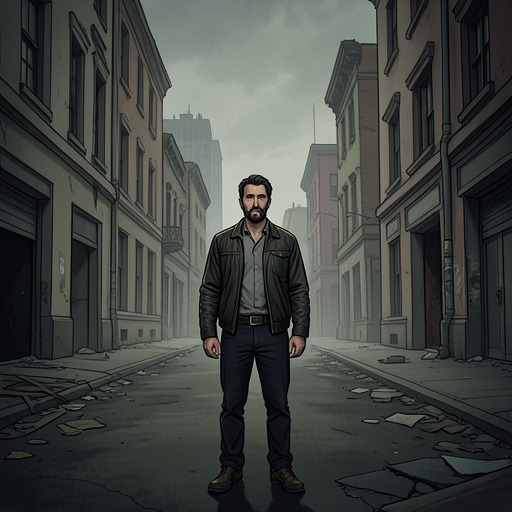
From Local Failure to World War
This thread follows the characters’ uncertain understanding of a household blackout as Martin’s talk expands it into a global conflict.
